

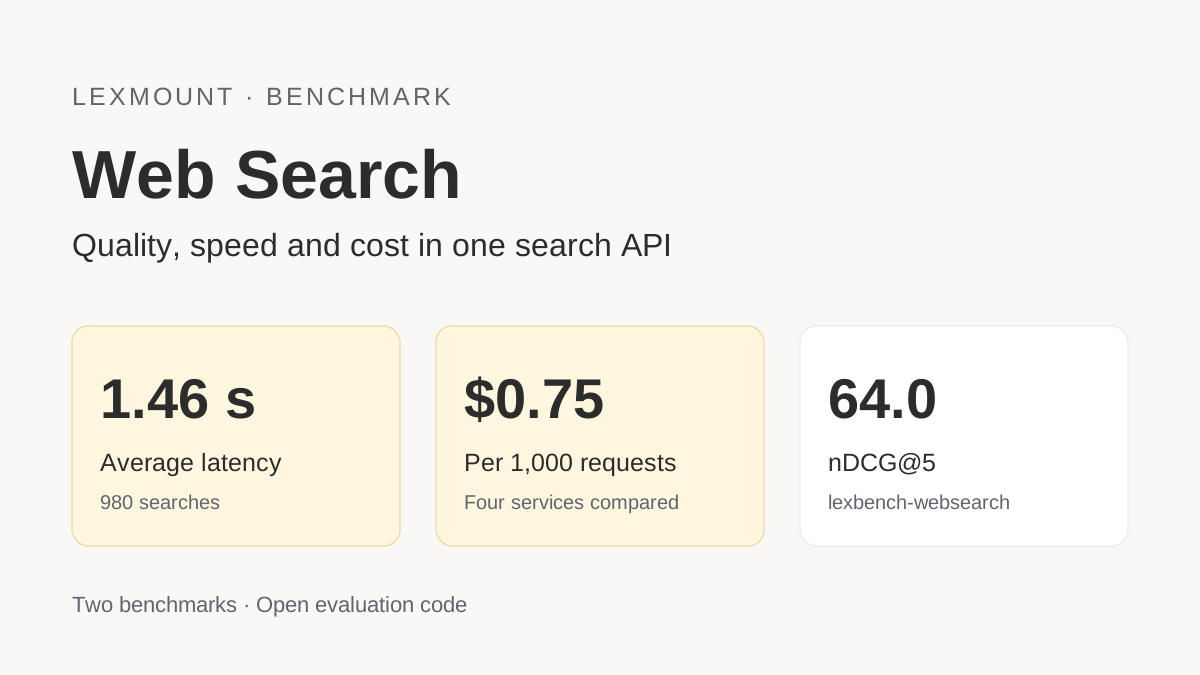
Today Lexmount AI is launching Lexmount Web Search on our browser platform. We ran 980 searches across two benchmarks and compared it with Serper, Bright Data SERP API and Browserbase Search. Lexmount Web Search answers in 1.46 seconds on average and costs $0.75 per 1,000 requests, making it the fastest and the cheapest of the four. On retrieval quality it scores 64.0 nDCG@5 on lexbench-websearch, our own benchmark, just behind Serper at 64.4.
1|Background: search first, then fetch
Whenever an agent has to deal with recent events, look up a long-tail fact, or cite where an answer came from, it has to go to the web. That usually takes two calls: a web search to find the right pages, then a web fetch to read the one it picked. Here is what that looks like for a question about a paper:
…
## 3.1 Encoder and Decoder Stacks
The encoder is composed of a stack of N = 6 identical layers. …
Our previous post benchmarked Moli's Web Fetch[1]. This one covers the step before it. A web search takes a query and returns a ranked list of pages, each with a title, a URL and a snippet. That shape is what we call a SERP (search engine results page). If the page the agent needs isn't near the top, there is nothing useful left to fetch.
Agents rarely search once. A single task can take several rounds, and every round adds wait time and cost. So for an agent, three things matter about equally: whether the results are right, how fast they come back, and what each call costs. This benchmark looks at all three.
2|Results at a glance
Quality numbers come from two benchmarks. lexbench-websearch is our own set of 149 search tasks modeled on how agents actually search; we call these "scenario queries" below. SimpleQA Verified is a public set of short fact questions, 773 of which we used; we call these "fact questions". The table below puts speed, price and retrieval quality side by side. The best value in each row is shown in green.
| Metric | LexmountWeb Search | Serper | BrowserbaseSearch | Bright DataSERP API |
|---|---|---|---|---|
| Avg. latency 980 calls | 1.46 s | 2.26 s | 3.97 s | 46.41 s |
| Price / 1K requests | $0.75 | $1.00 | $5.00 | $1.50 |
| nDCG@5 lexbench | 64.0 | 64.4 | 58.8 | 23.2 |
| Precision@5 lexbench | 62.7% | 71.9% | 62.4% | 25.8% |
| Success@5 lexbench | 77.2% | 74.5% | 71.1% | 25.5% |
| Hit@5 SimpleQA | 78.0% | 80.2% | 76.3% | 30.1% |
| MRR@5 SimpleQA | 0.645 | 0.720 | 0.513 | 0.267 |
| Answer Match@5 SimpleQA | 72.1% | 69.0% | 20.8% | 27.7% |
Lexmount Web Search comes first on speed and price and second on quality. It is within half a point of Serper on nDCG@5 and ahead of it on Success@5 and Answer Match@5. Serper leads on Precision@5 and on finding the labeled sources in SimpleQA Verified. Browserbase Search returns no snippets in the mode we tested, which hurts it on every snippet-based metric. Bright Data timed out or failed on nearly half of its requests, and its scores drop accordingly.
Why these four? The answer starts with what different "search" APIs actually return.
3|What search APIs return
Plenty of APIs have "search" in the name, but they hand back very different things. We group them into three layers by what a single call returns. Moving from L1 to L3, the output gets more ready to use and harder to verify.
| Layer | Title · URL | Short snippet | Summary / content | Generated answer | Examples (endpoint or parameter in brackets) |
|---|---|---|---|---|---|
| L1Search results (SERP)This benchmarkThe list of pages a search engine returns | ✓ | ✓ | — | — | Lexmount Web SearchSerperSerpApiBright Data SERP APIBrowserbase SearchBrave Web SearchPerplexity Search APIZhipu Web Search |
| L2Page contentResults plus a long summary or the page text | ✓ | ✓ | ✓ | — | DeepSeek Search API need_contentBocha Web Search summaryExa Search contentsTavily Search raw_contentBrave LLM ContextParallel Search excerpts |
| L3Generated answerA model reads the pages and answers with citations | citations | — | — | ✓ | Bocha AI SearchPerplexity Agent APIExa AnswerTavily Search include_answerBrave AnswersParallel Task APIGemini Grounding with Google SearchxAI web_searchZhipu Search in Chat |
One vendor's endpoints can sit in different layers, so the table classifies endpoints, not companies.
We picked our three peers deliberately. Browserbase and Bright Data are cloud browser providers, like Lexmount, and both now ship a SERP endpoint. Serper is the reference point for dedicated SERP APIs. Most other products in the table span L1 through L3 and aren't really SERP services: they read pages, or even write the answer, inside one call, so their latency and price aren't comparable to a service that returns a list of links.
Lexmount Web Search is an L1 service, which makes retrieval the thing to measure: are the right pages in the top five, and are they in the right order? L2 summaries and page content and L3 answers aren't available in Lexmount Web Search yet. They're on the way. Until then, an agent that needs the full text can pass the one or two URLs it picked to Moli's Web Fetch.
4|Methodology
We used two question sets. 773 fact questions from the public SimpleQA Verified benchmark test whether a service can find the source pages labeled in the dataset. 149 scenario queries from our own lexbench-websearch test whether the top five results are actually useful to an agent. Each set is scored on its own; we don't blend them into one number.
4.1Public benchmark: SimpleQA Verified
SimpleQA is OpenAI's short-form factuality benchmark: every question has a single, checkable answer[2]. Google DeepMind deduplicated it and fixed bad labels to produce SimpleQA Verified, a 1,000-question set[3] in which each question also lists the source pages that support its answer[4]. Here is one question as it appears in the dataset:
For every service we check whether a labeled source shows up in the top five results, and whether the gold answer appears in any title or snippet.
The full set spans 10 topics, led by politics, science and technology, and art. Answers fall into five types (date, person, number, place and other), all of them short entities or phrases.
Topics
Answer types
So that every service gets the identical query, we kept the 831 questions of 128 characters or fewer, all of which count toward latency. Dropping 58 with flawed gold answers leaves 773 for the quality metrics.
This set is good at telling whether the expected page was found, but it has three blind spots:
- Only stable facts. Most questions are encyclopedic and long-lived, so freshness goes untested.
- No targeted requests. Agents often ask for a specific site or an official source. The dataset has none of that.
- Only labeled sources count. A page that gives the right answer but isn't on the label list scores as a miss.
In short, SimpleQA Verified tells us whether the labeled source was found, not whether the top five results would help an agent. That gap is why we built our own set.
4.2Our benchmark: lexbench-websearch
lexbench-websearch[5] contains 149 queries drawn from the way agents actually search. Most are general web queries, and many state a source requirement in the query itself, such as a specific site or an official source.
Query types
Source requirements
Three design rules, one for each blind spot above:
An LLM judge does the grading. It sees only the query, the title and the snippet, never the service name, the URL or the original rank. Each result gets 0–3: 3 fully answers the need, 2 partly helps, 1 is on topic but adds nothing useful, and 0 is irrelevant or breaks the source rule. Here is one query with each service's top-five grades:
| Service | #1–#5 | nDCG@5 |
|---|---|---|
| Ideal ranking | 33222 | 100.0 |
| Lexmount Web Search | 21202 | 40.9 |
| Serper | 22330 | 74.2 |
| Browserbase Search | 31221 | 70.3 |
| Bright Data SERP API | 00000 | 0.0 |
nDCG@5 weights the five grades by rank and divides by the score of the ideal ranking. The ideal ranking comes from the pooled top five of all four services; for this query it is 3, 3, 2, 2, 2. None of Lexmount Web Search's five results fully answered the question, so it scores 40.9 here.
4.3Metrics
| Metric | What it measures | Benchmark |
|---|---|---|
| nDCG@5 | Ranking quality of the top five: higher when better-graded results sit higher. Shown × 100 | lexbench-websearch |
| Precision@5 | Share of top-five results graded 2 or higher | lexbench-websearch |
| Success@5 | Share of queries with at least one result graded 3 | lexbench-websearch |
| Hit@5 | Share of questions whose top five include a labeled source | SimpleQA Verified |
| MRR@5 | Reciprocal rank of the first labeled source, 0 if none; higher means it ranks earlier | SimpleQA Verified |
| Answer Match@5 | Share of questions where the gold answer appears in a top-five title or snippet | SimpleQA Verified |
| Latency | End-to-end time measured on the client, including failed requests and retry waits | All 980 calls |
4.4Services and test rules
Every service was asked for the top five organic results, with page fetching and answer generation turned off. The exact settings:
| Service | Settings | Fields returned |
|---|---|---|
| Lexmount Web Search[6] | query + limit=5 | Title · URL · snippet |
| Serper[7] | Google search; num=5, gl=us, hl=en | Title · URL · snippet |
| Browserbase Search[8] | Parallel Advanced mode; numResults=5 | Title · URL (no snippet in this mode) |
| Bright Data SERP API[9] | Google search; parsed_light JSON, gl=us, hl=en | Title · URL · snippet |
We reviewed all 3,920 outputs (980 queries × 4 services) question by question.
5|Results in detail
5.1Side by side: two "official source" queries
First, two scenario queries that explicitly ask for official sources. On the first, Lexmount Web Search puts the official spec at #1. On the second, its only official page sits at #5. Below are each service's top five results, with the judge's grade on the left. Browserbase has no snippets, so its five official pages get a 2 apiece. Both queries are in Chinese, as in the benchmark.
Grades: 3 fully answers · 2 partly helps · 1 on topic, nothing useful · 0 irrelevant or breaks the source rule
Grades: 3 fully answers · 2 partly helps · 1 on topic, nothing useful · 0 irrelevant or breaks the source rule
5.2Scenario queries (lexbench-websearch)
Across the 149 scenario queries, Lexmount Web Search scores 64.0 nDCG@5, a hair behind Serper's 64.4, with Browserbase at 58.8. We're still tuning the ranking and expect to close that gap. Lexmount Web Search has the highest Success@5, so it usually gets at least one result that fully answers the query into the top five. Its Precision@5 of 62.7% trails Serper's 71.9%, though: more of its top five are noise.
nDCG@5

Precision@5

Success@5

By query type, Lexmount Web Search does best on site-specific queries, at 73.5 nDCG@5 against Serper's 63.0. On general web queries, the largest group, it scores 61.4, slightly below Serper's 64.9.
| nDCG@5 by query type | LexmountWeb Search | Serper | BrowserbaseSearch | Bright DataSERP API |
|---|---|---|---|---|
| General web 118 queries | 61.4 | 64.9 | 60.7 | 26.9 |
| Site-specific 25 queries | 73.5 | 63.0 | 44.7 | 11.2 |
| Vertical 6 queries | 74.4 | 59.9 | 78.7 | 0.0 |
The vertical group has only 6 queries; treat it as indicative.
5.3Fact questions (SimpleQA Verified)
On the 773 fact questions, Serper finds a labeled source in its top five for 620 of them, Lexmount Web Search for 603 and Browserbase for 590. Serper also ranks those sources higher, with an MRR@5 of 0.720 against Lexmount Web Search's 0.645.
Hit@5

MRR@5

Answer Match@5

Answer Match@5 only asks whether the gold answer text appears in a title or snippet. Lexmount Web Search reaches 72.1% here, a bit above Serper's 69.0%. Browserbase can only match on titles and lands at 20.8%.
5.4Speed and cost
Over all 980 calls, Lexmount Web Search averages 1.46 seconds. Serper averages 2.26 seconds and Browserbase 3.97. Bright Data returned errors on 484 of its 980 requests, 326 of them still unanswered at the 60-second timeout, which pushes its average to 46.41 seconds.
The gap widens in the tail. On scenario queries, 95% of Lexmount Web Search requests come back within 2.06 seconds; Serper needs 4.69.
All four services charge per 1,000 requests. Lexmount Web Search is the cheapest at $0.75, against $1.00 for Serper, $1.50 for Bright Data and $5.00 for Browserbase.
Average latency

Price per 1,000 requests

5.5Where Serper still leads
Serper serves Google's results. Going through the per-query output, the gap between it and Lexmount Web Search comes down to four things:
Noise in the top five
On the MCP query, Lexmount Web Search has the official spec at #1, but three of its five results score 0.
Source rules not applied
The Python TaskGroup query asks for official docs; Lexmount Web Search's first four results aren't official pages.
Snippets miss the key facts
On the DeepSeek pricing query, Lexmount Web Search's snippets leave out the price itself, so none of its five results gets a 3.
Labeled sources rank too low
Asked where "To Serve and Protect" first aired, Serper has Wikipedia at #1; Lexmount Web Search misses it in the top five.
All four come down to ranking and snippets, and that's where our next round of work goes.
6|Wrap-up and what's next
Where we stand
Faster and more accurate
A bigger, fresher benchmark
Among the four SERP APIs we tested, Lexmount Web Search is the fastest and the cheapest, and its retrieval quality is already close to Serper's, ahead on Success@5 and Answer Match@5. Next we're working on ranking and snippets to lift Precision@5 and source hits on fact questions, with the goal of passing Serper on quality. At the same time we'll keep working on speed to bring average latency under one second.
The benchmark has limits. The scenario set has only 149 queries, mostly general web, with just 6 vertical ones. SimpleQA Verified is a fixed set and can't test freshness. And the judge sees only titles and snippets, not the pages behind them. We plan to grow the set and add new queries in dated batches. The evaluation code and the queries are open source, and we'd welcome corrections.
You can try your own queries in the Playground right now, or grab an API key and plug Lexmount Web Search into your agent. Questions or ideas? Reach us through the contact page, on X or on Discord, or open an issue on the Moli[10] GitHub repo.
Appendix|Open source and reproducibility
The benchmark runs on Browser Eval[11]. Add API keys for the four services and a single command reruns it with the same settings. The scenario queries, source rules and scoring code live in lexbench-websearch. If you spot a labeling or scoring problem, issues and PRs are welcome.
🛠 Browser Eval
One command reruns all four services
📦 lexbench-websearch
149 scenario queries and scoring code
📏 SimpleQA Verified
1,000 short fact questions
The benchmark calls live search services, so reruns may show small differences in results and latency for some queries.
References
- Moli Web Fetch benchmark: our earlier post on web fetch quality.https://browser.lexmount.com/en/blog/webfetch-benchmark
- SimpleQA: OpenAI's short-form factuality benchmark.https://arxiv.org/abs/2411.04368
- SimpleQA Verified: Google DeepMind's revised 1,000-question SimpleQA.https://arxiv.org/abs/2509.07968
- SimpleQA Verified dataset: questions, answers, topics, answer types and source URLs.https://huggingface.co/datasets/google/simpleqa-verified
- lexbench-websearch: Lexmount's open web search benchmark, with queries, source rules and scoring code.https://github.com/lexmount/lexbench-websearch
- Lexmount Web Search: Lexmount's SERP API; see the quickstart for docs.https://browser.lexmount.com/en/ · https://browser.lexmount.com/en/docs/websearch/quickstart
- Serper: a SERP API serving Google results.https://serper.dev
- Browserbase Search: Browserbase's web search endpoint.https://docs.browserbase.com/platform/search/overview
- Bright Data SERP API: Bright Data's search results API; pricing on its pricing page.https://brightdata.com/products/serp-api · https://brightdata.com/pricing/serp
- Moli: Lexmount's open-source browser for agents.https://github.com/lexmount/moli
- Browser Eval: Lexmount's open-source evaluation framework for browsers and web tools.https://github.com/lexmount/browser-eval